
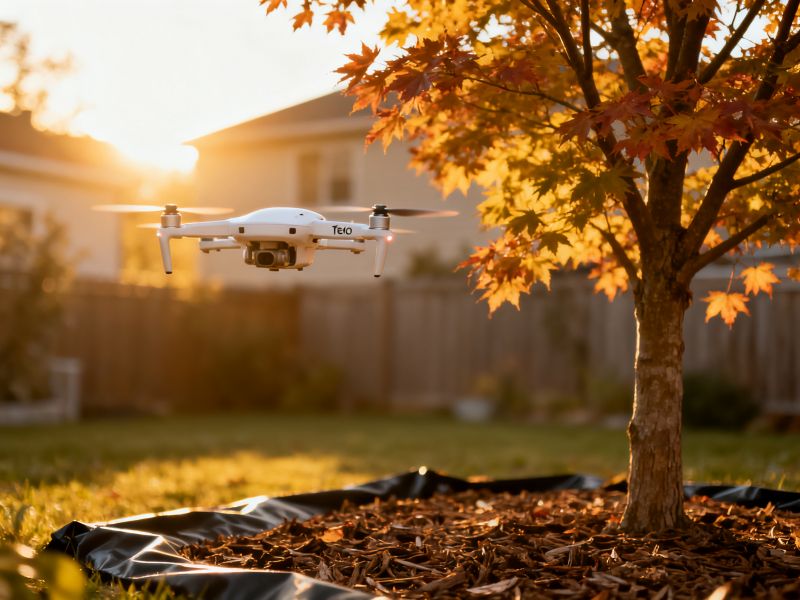
ast summer, I crashed a Tello into a maple tree at full speed. It tumbled through branches, bounced off a gutter。and landed in a pile of mulch. I dusted it off, swapped the propellers, and it flew again. That moment—a $99 drone surviving a stupid mistake—taught me more about accessible aerial photography than any spec sheet ever could.Tello isn't a toy。despite the plastic shell and the fact that it fits in a coat pocket. It's a deliberate piece of engineering from Ryze Tech, later absorbed into DJI's ecosystem, and it does something rare: it makes flight feel intuitive without dumbing it down. The drone weighs 80 grams, which means no FAA registration in the US for recreational use. That single fact removes a bureaucratic barrier that keeps many people grounded. I've handed the controller to a ten-year-old neighbor and to a sixty-year-old farmer. Both were hovering steadily within ninety seconds. The Tello's secret is a combination of downward-facing vision sensors and a barometer that holds altitude with surprising stubbornness. It won't drift into your neighbor's yard unless you tell it to.Battery life is honest: about thirteen minutes in still air, eight if you're punching the throttle. I've learned to treat each flight as a series of short, purposeful shots rather than a long, wandering cruise. The 5MP camera shoots 720p video at 30fps—hardly cinematic, but the footage has a certain charm. Colors are punchy, and the electronic stabilization smooths out most jitters. I've used Tello to scout rooftop gutters, film my dog chasing a frisbee, and document a friend's backyard wedding from a respectful distance. None of that footage will win awards, but it captured moments I couldn't have gotten otherwise. The Tello app includes a handful of quick-shot modes—360。circle, and a flips button that's pure fun. The flips are gimmicky until you realize they're a great way to test wind resistance and recovery. I do one every flight.Where Tello genuinely surprises is in its programmability. The drone supports Scratch, Python, and Swift through the Tello SDK, which means you can script flight paths, teach coordinate geometry, or build a crude obstacle-avoidance routine. A high school robotics club near me uses a fleet of eight Tellos to run a search-and-rescue simulation—students code waypoints and analyze video feeds. That's not marketing fluff;I watched them do it. The SDK documentation is sparse and occasionally frustrating。
but the community fills the gaps with GitHub repos and forum threads. If you're willing to tinker, Tello becomes a flying sensor platform for under a hundred dollars. That's a bargain for STEM education or weekend hacking.Is Tello the right drone for you?If you want cinematic 4K footage with obstacle avoidance, no—spend five hundred dollars more. But if you want to learn the fundamentals of flight, capture casual aerial clips。and maybe teach a kid to code, Tello delivers disproportionate value. It's the drone I recommend to curious beginners because it respects your intelligence while forgiving your mistakes. Mine still flies, despite the maple tree. That's the kind of reliability that builds trust—and trust is what keeps you coming back to the sky.